
Home / Workflow Automation
End-to-end workflow automation, built for scale
Stop drowning in manual work. Automate your core business operations.
We bridge the gap between your legacy infrastructure and modern, intelligent orchestration engines.
We design, build, and scale custom workflow automation pipelines for banks, fintechs, and high-growth enterprises — cutting turnaround times by up to 80% and eliminating operational bottlenecks.
Customer onboarding
Unacceptable delays that lose customers before they are ever activated.
Compliance vulnerabilities
Manual checks introduce human error, risking regulatory penalties and audit failures.
Bloated overhead
Highly skilled compliance and operations teams spend hours on repetitive, low-value data shuffling.
KYC automation
Intelligent onboarding, orchestration and case management.
Intelligent Onboarding & KYC Automation
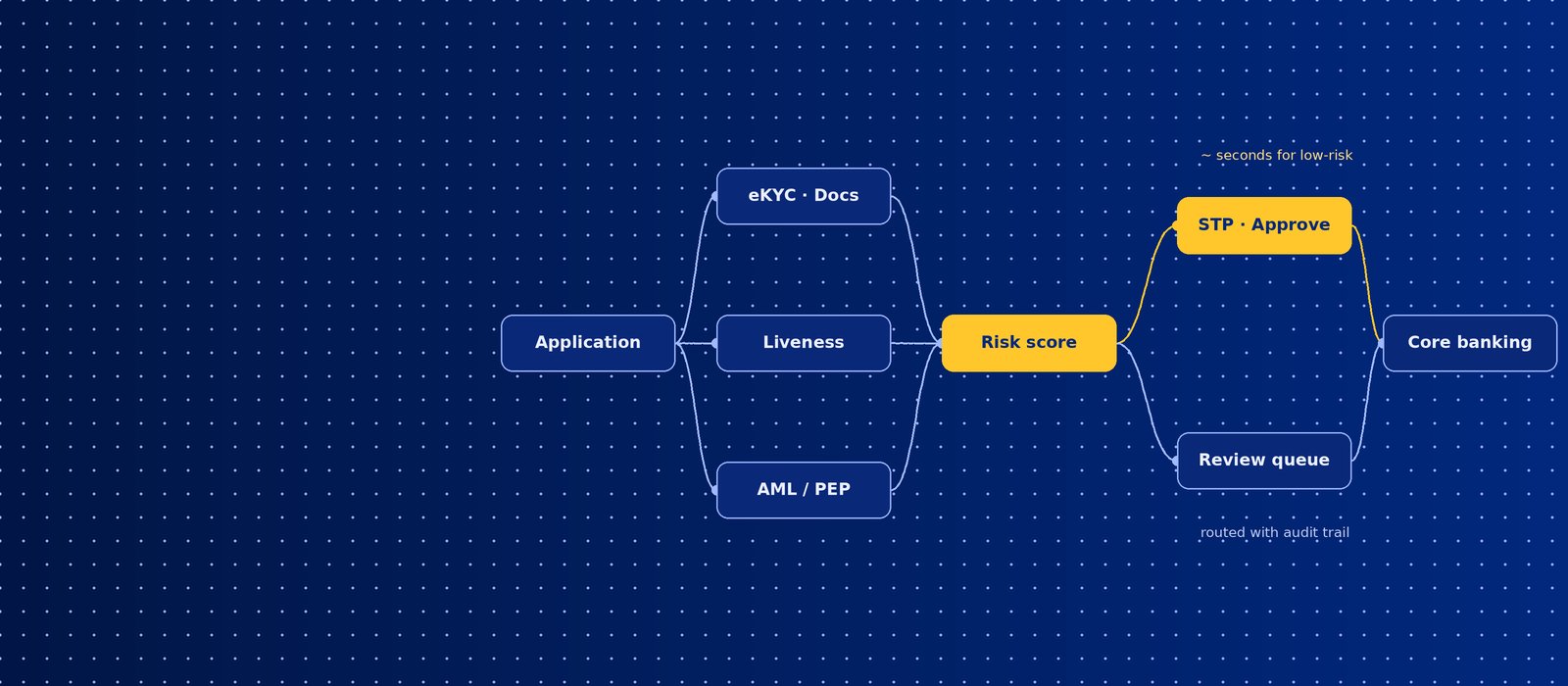
Streamline customer acquisition with automated eKYC, instant document verification, biometric liveness checks, and real-time AML/PEP screening. Implement risk-based straight-through processing (STP).
Process Orchestration & Integration
Connect disparate systems — CRMs, core banking platforms, third-party verification APIs, and databases — using a robust workflow engine to ensure seamless data flow.
Exception & Case Management Queues
Build intelligent routing systems that automatically route high-risk or flagged cases to human reviewers with pre-populated audit trails, slashing manual review times.
Use case results
85%
Reduction in onboarding turnaround time
Zero
Compromise on regulatory compliance & audit readiness
40%
Lower cost-per-acquisition operational overhead
Checklist
Before automating your KYC pipeline
Before writing a single line of code or plugging in an orchestration engine: rushing into KYC automation without addressing structural inefficiencies can lead to costly project failures, regulatory gaps, and poor user experiences. Use this checklist to identify and resolve critical bottlenecks before starting your automation journey.
| Bottleneck & focus area | The core problem | The business impact | Actionable fix |
|---|---|---|---|
| 1. Fragmented Data Silos & Legacy Systems | Customer data is trapped across disconnected legacy databases, core banking systems, and third-party tools, lacking a single source of truth. | Automated workflows fail or stall because they cannot fetch, update, or sync customer profile data in real time. | • Map existing data architecture. • Define standardized data schemas and set up centralized API endpoints or CDPs (Customer Data Platforms). |
| 2. Ambiguous Risk Matrices & Rule Thresholds | Compliance and risk teams rely on subjective, undocumented rules or manual intuition to grade applicant risk. | Rules engines break down, causing excessive false positives or letting high-risk profiles slip through Straight-Through Processing (STP). | • Formalize risk appetite matrices (Low, Medium, High risk criteria). • Document exact criteria for STP vs. manual review. |
| 3. Unoptimized Exception & Manual Review Queues | Manual reviews are treated as an afterthought, ending up in disorganized spreadsheets or chaotic shared email inboxes. | Flagged profiles get stuck in a “black hole,” driving onboarding turnaround times back up to days despite fast ingestion. | • Design a dedicated internal Case Management interface with audit trails. • Implement intelligent routing to assign cases by expertise or workload. |
| 4. Single-Point-of-Failure (SPOF) Vendor Dependencies | Complete reliance on a single third-party OCR, biometric, or AML screening provider without built-in backup options. | Vendor downtime or API latency freezes the entire onboarding funnel, causing user drop-off and lost revenue. | • Architect workflows with secondary fallback providers / degradation pathways. • Enable request queuing or local encrypted storage during outages. |
| 5. Undefined Security, Consent & Data Residency | Overlooking local data privacy laws (e.g., GDPR, CCPA) governing how PII (Personally Identifiable Information) is handled. | Triggers severe regulatory penalties, heavy compliance fines, and critical security vulnerabilities during audits. | • Implement end-to-end encryption (TLS 1.3 in transit, AES-256 at rest). • Establish clear data retention and automated purging policies. |
Benefits of automation
- Freefall reduction in turnaround time (TAT): Onboarding drops from days or weeks (in manual setups) to mere minutes or seconds for low-risk customers.
- Operational cost efficiency: Minimizes manual data entry and human review overhead, allowing compliance teams to focus solely on complex, high-risk cases.
- Enhanced audit readiness: Every action, system check, and decision is timestamped and logged automatically, creating an immutable audit trail for regulators.
- Lower false positives: Modern AI-driven screening tools reduce the number of false-positive name matches, preventing unnecessary friction for legitimate customers.
Best practices
- Adopt a Risk-Based Approach (RBA): Do not apply the exact same workflow to every customer. Implement Simplified Due Diligence (SDD) for low-risk retail clients and Enhanced Due Diligence (EDD) triggers for corporate accounts or high-risk jurisdictions.
- Ensure fallback mechanisms: Build graceful degradation into the system. If a third-party OCR API experiences downtime, the workflow should queue the request or route it to a manual staging area rather than block the user entirely.
- Prioritize data security & privacy: Ensure all PII (Personally Identifiable Information) is encrypted in transit and at rest.
Resilient by design
Eliminating manual recovery entirely.
No more starting over when something goes wrong. Our automated pipelines remember every step they take, meaning any system downtime is handled automatically with a seamless pick-up right where they left off.
Start small
Ready to build your first KYC workflow?
Begin with one flow, then add a check, insert a review step, update a policy rule — all without reopening the services that run your business, so core application services never need rewriting.